“Some journeys are planned. Others simply find you.” Unknown
Greetings from Romania! 🇷🇴
I know what you’re thinking…
“Why on earth is Emily in Romania?”
Fair question.
Let me explain.
Last year, while hiking the Via Francigena across Italy, I met a wonderful Romanian couple cycling through Tuscany. When I told them about my pilgrimage, they immediately said,
“You have to hike the Via Transilvanica!”
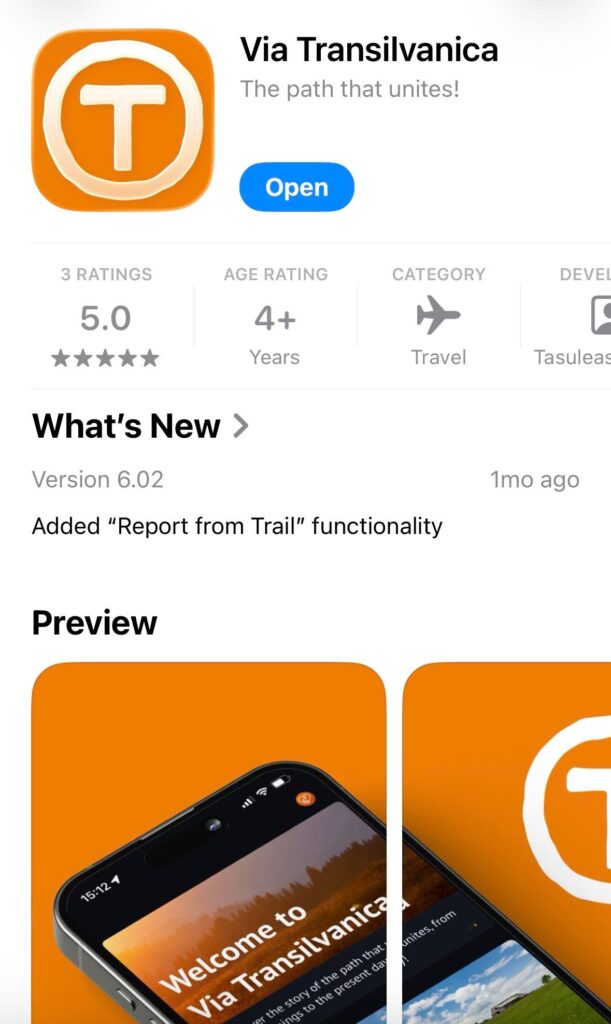
They pulled up the app, showed me the website, and helped me download the free guidebook to my phone…
…and apparently that was all the convincing I needed.
So here I am.
Ta-da! 🪄
Apparently, I’m incredibly easy to persuade.
Am I prepared?
Absolutely not.
I downloaded the guidebook…
…and then never opened it.
So we’ll be discovering Romania and the Via Transilvanica together.
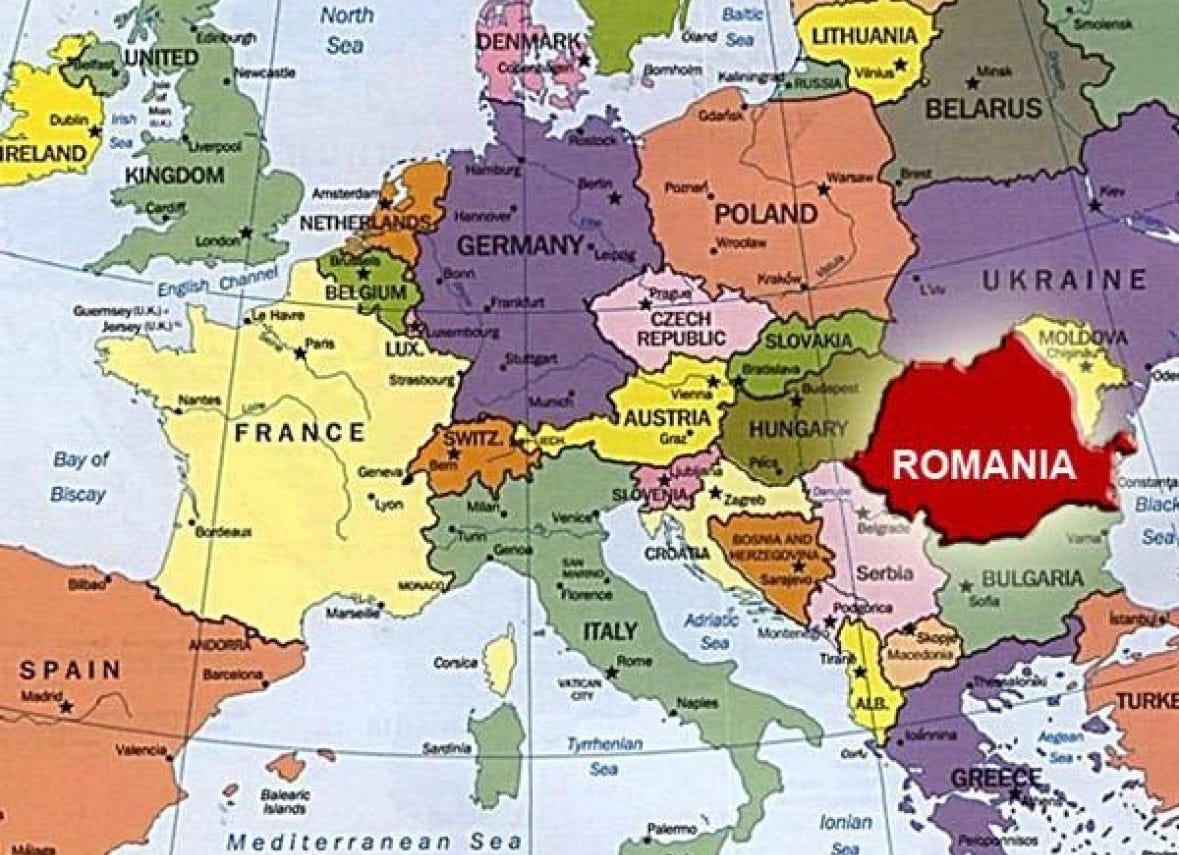
And for those of you who don’t know where Romania is, let me provide you a map.
Being from Kansas, I can’t help but feel a connection to Romania. Kansas has spent years being labeled a “flyover state,” where people pass overhead without ever stopping to see what makes it special. Romania strikes me in a similar way – a country many travelers overlook in favor of Europe’s more famous destinations. But if my first few days are any indication, they’re missing out.
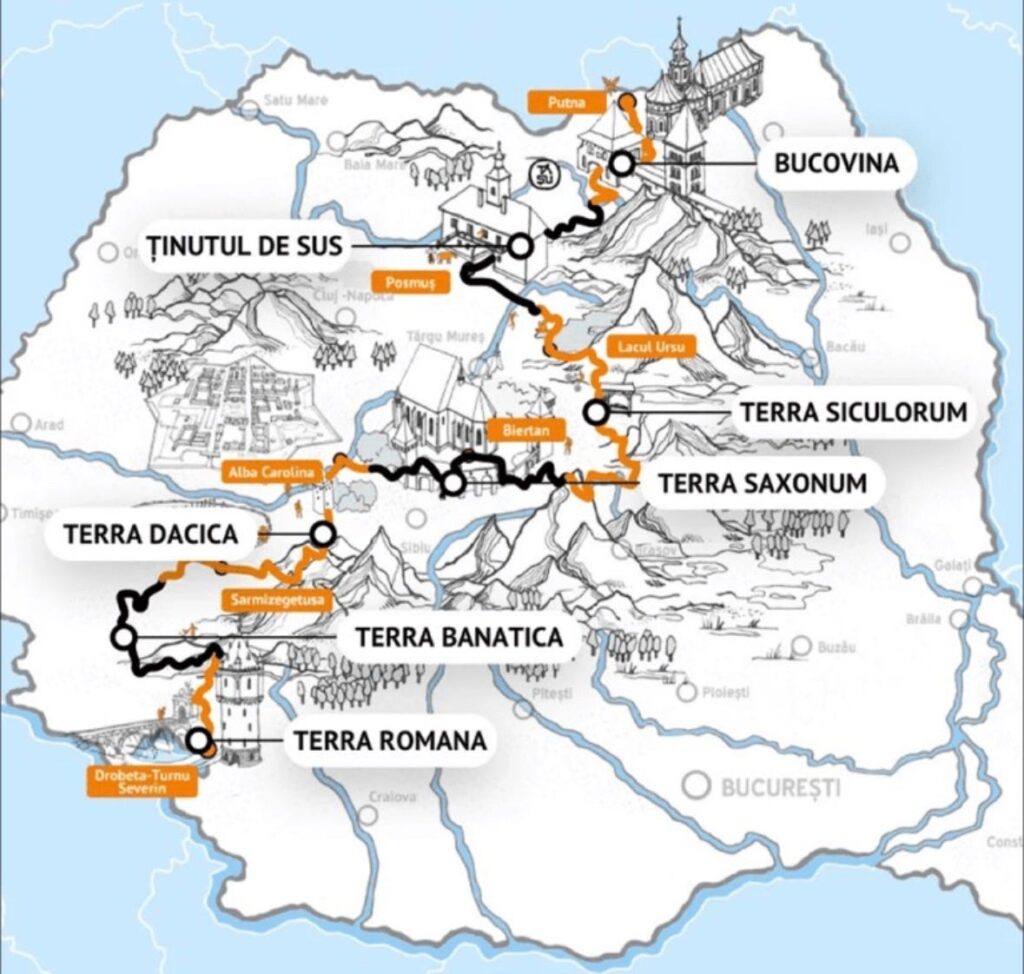
Below are some quick hits about the Via Transilvanica – The Road That Unites.
-
Approximately 1,400 km (870 miles) long.
-
Runs from Putna Monastery (5-10 miles from the Ukrainian border) in northern Romania to Drobeta-Turnu Severin on the Danube (Serbian border).
-
Crosses 10 regions, 12 UNESCO-related sites, and hundreds of villages.
-
Passes through forests, mountain ranges, rolling farmland, Saxon villages, Hungarian communities, and Romanian Orthodox monasteries (Putna is one of those).
-
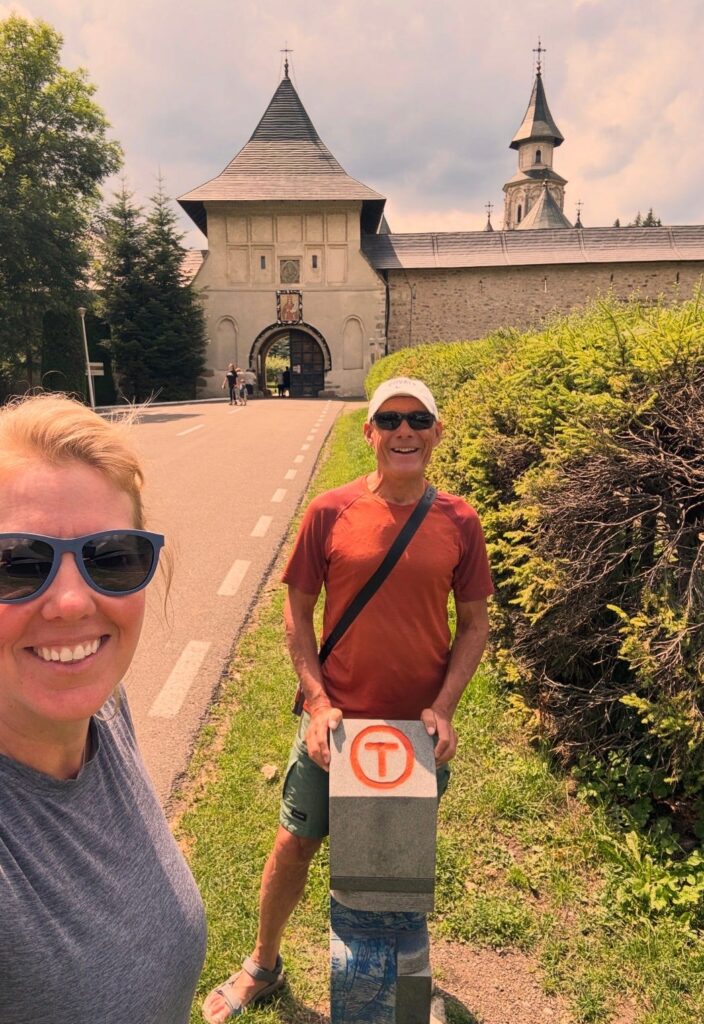
Every kilometer is marked by a uniquely carved stone marker, each created by a different artist. I love this!
-
The trail was created by the NGO Tășuleasa Social to connect Romania’s diverse cultures and landscapes through slow travel.
-
They have BEARS! Europe’s largest brown bear population lives here. 🐻 Seriously, it’s not a joke. Everyone has warned me about the bears. “Get bear spray and bells for your shoes.” As I now, I have neither.
I tried to pack light for this Camino since it has a lot of mountain climbing but I failed. It’s the heaviest bag I’ve carried on a Camino to date.
Why?
Great question.
Sandals.
If you’ve followed my Camino adventures, you know there’s a never-ending debate between Team Hiking Shoes and Team Sandals.
I’ve always been firmly Team Shoes. Mostly because I don’t like carrying extra weight and also, I feel weird with my feet exposed while walking through the woods or tall grasses. There are creepy crawlers on the ground. Ew.
But enough experienced hikers have sworn by sandals that I’ve decided to give them a chance.
If they don’t work…they’ll be the first thing sacrificed to lighten my pack.
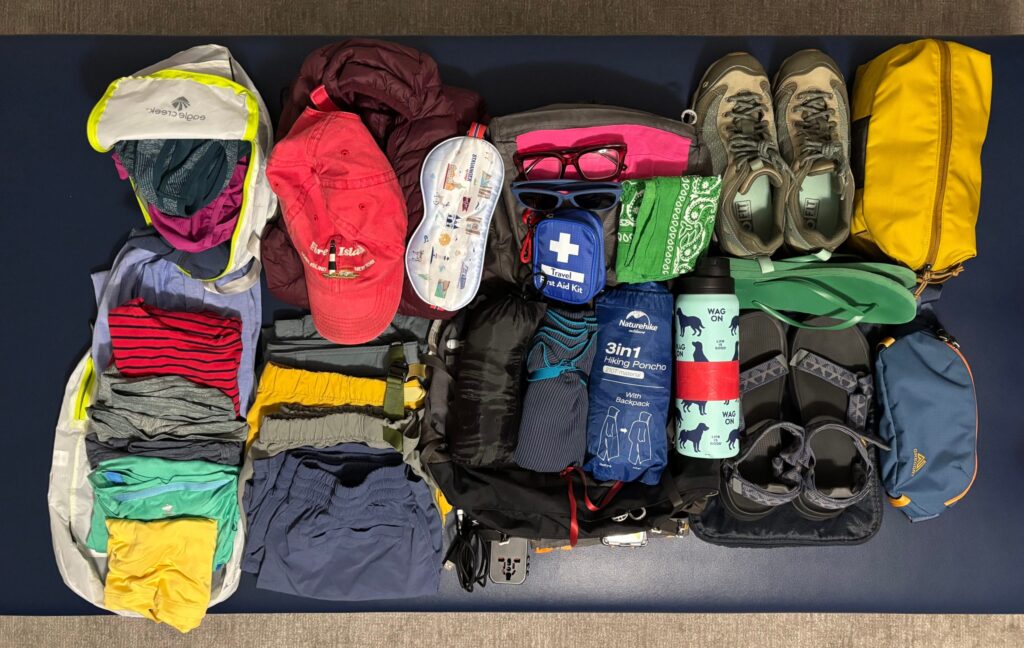
In addition to the sandals, I have another first on this trip.
A hiking partner.
I usually prefer to travel solo and meet people along the way but when I told Massimo (the guy I hiked with on the VF – he is Team Sandals) the story about meeting the Romanians, he said if I decided to hike the VT, he would like to join me.
I gave the “Okay” only because I think he will be a tremendous asset along the journey and not cramp my style.
First. Since he speaks Italian and so do many ROMANians, this skill will definitely come in handy.
Second. He may be fast on a bicycle, but I think I can out run him. Which means, in theory, he’ll make excellent bear bait.
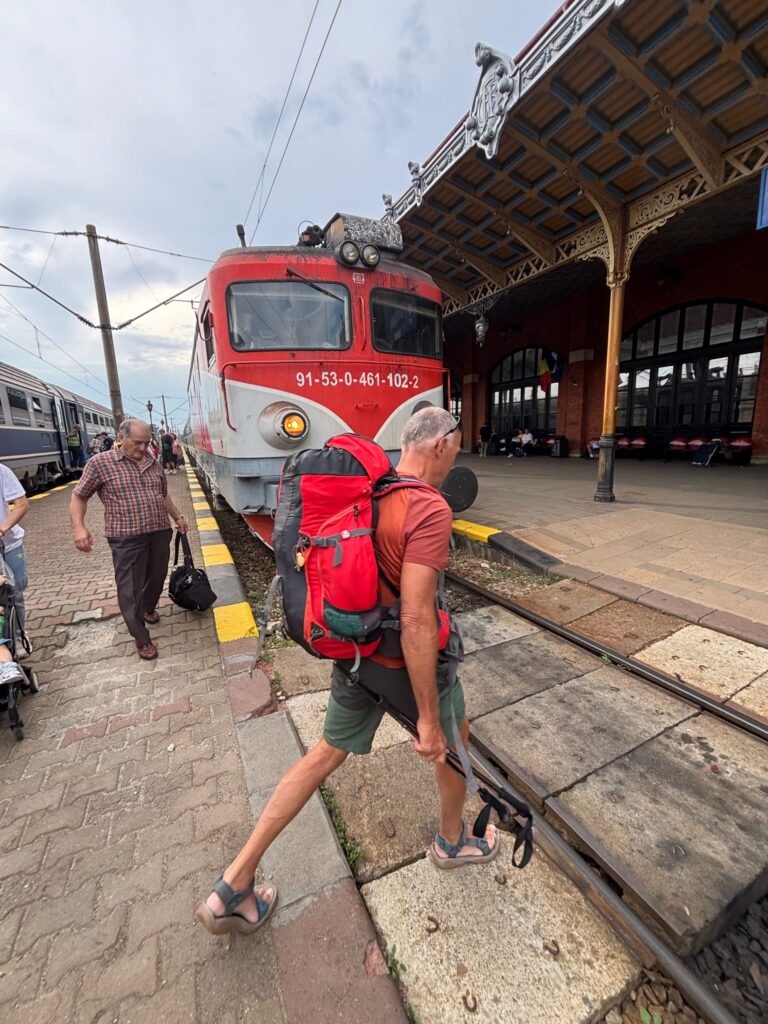
So far, he’s proven himself. Using his Italian, he has gotten us out of a few sticky situations on a couple of buses and trains between Bucharest and our starting point in Putna.
He can stay for now.
But if he gets hit by a train, it’s not my fault. (Don’t worry, the photo is just for dramatic effect, the train was stopped at the station crossing.)
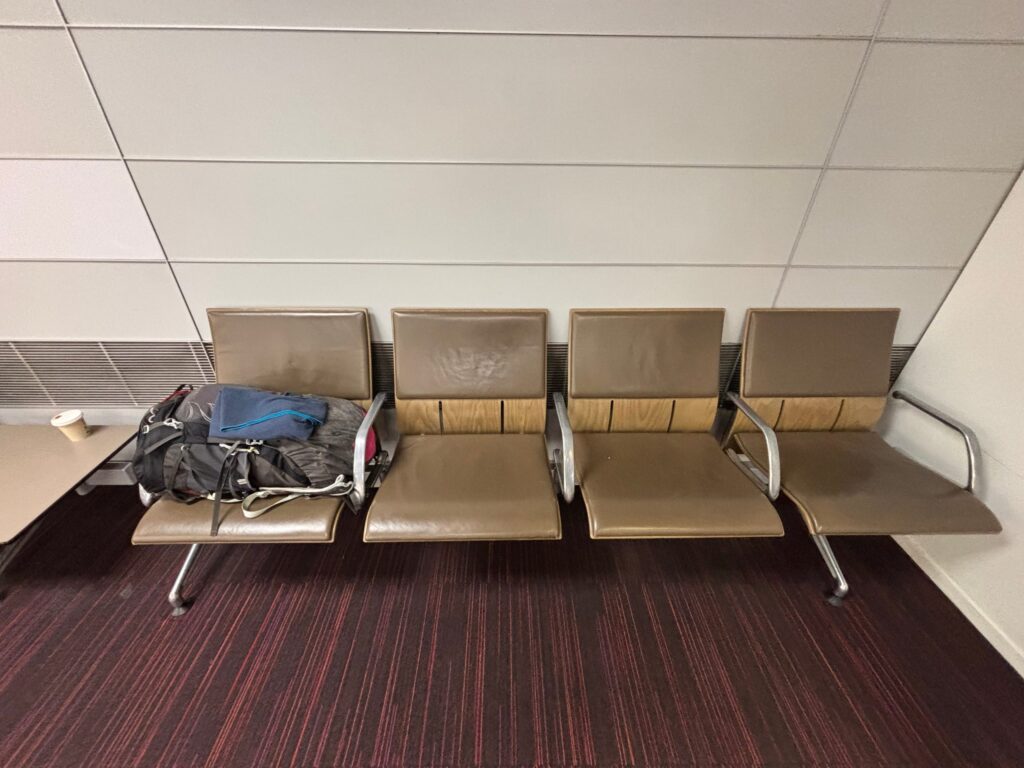
Getting to Romania was a bit of a nightmare. When I landed in France, I found out my flight from Paris to Bucharest was cancelled. So I took a nap on this oh-so-comfortable bench in the Charles de Gaulle airport while I waited for seven hours only to end up being re-routed through Warsaw, Poland (not on my original itinerary) and arrived in Bucharest at 2am.
Thirty hours of travel later…
I don’t recommend arriving in a country for the first time at 2:00 a.m. It ain’t pretty.
Air travel has become a bit of a dumpster fire since COVID.
Agree?
Maybe next time I’ll just take a boat across the Atlantic.
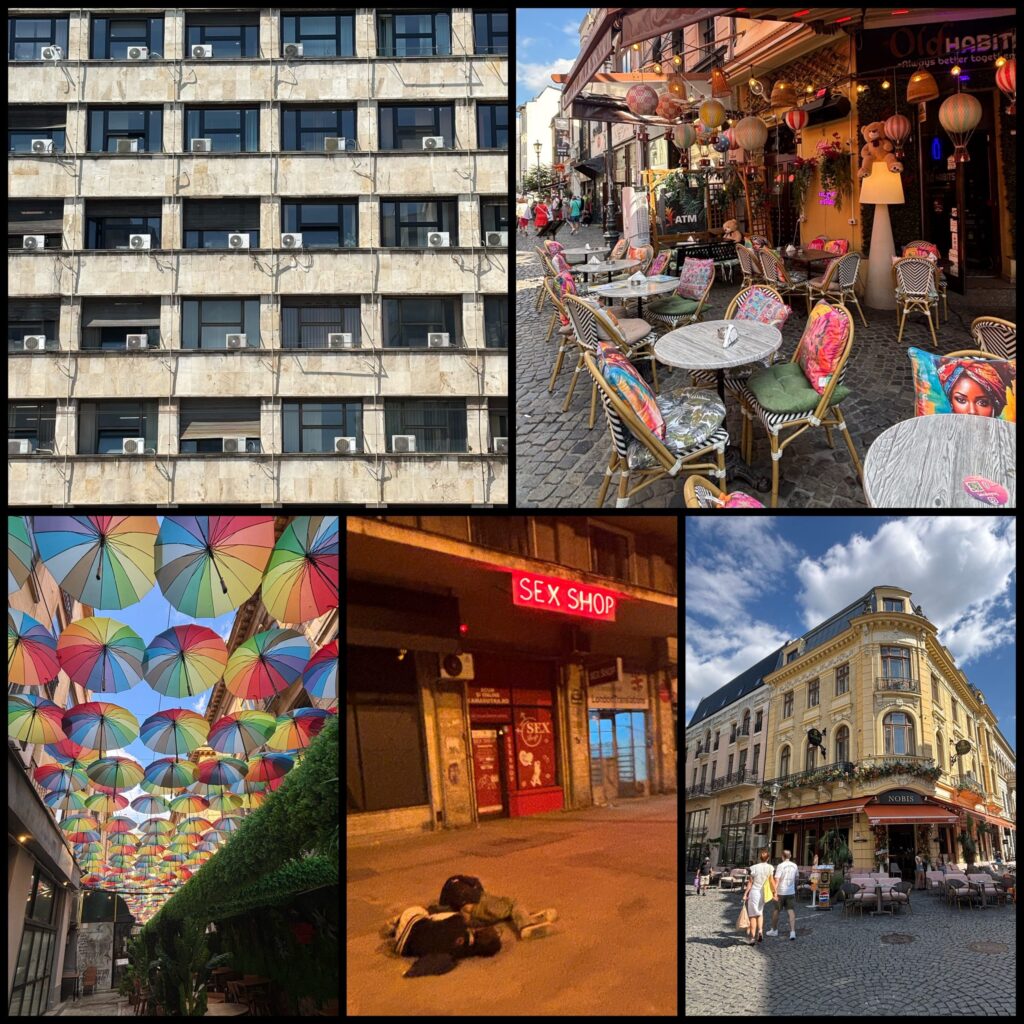
My first impression of Romania is that it is full of contrast.
Old communist era buildings that are crumbling next to trendy coffee shops and restaurants. Teslas in the cities vs. horse drawn carts in the countryside. Solar panels and wood burning stoves. Expensive high-end fashion vs. trends from 80 years ago (or more). High rollers and homeless. Sex shops and gentlemen parlors next to churches and parks.
Interesting and fascinating doesn’t begin to describe it.
Romania is on the verge of an explosion. It’s growing fast and will soon become a popular destination similar to the growth I’ve seen in Albania (just ask Ryanair).
As more people learn about the Via Transilvanica, I wouldn’t be surprised to see Romania become one of Europe’s next great long-distance hikes. 🥾
My favorite things about Romania so far are, hands down, the people and the food. Romanians are known for their warm and generous hospitality.
So far, that’s all we’ve received.
Even with the language barrier, they go out of their way to help us get to our destinations or offer suggestions for food, etc.
On the train from Bucharest to Suceava, the air conditioning in our car had stopped working.
It was hotter than Hades.
Everyone was fanning themselves with whatever they could find – passports, train tickets, phone cases…
Across from me sat a young woman, maybe 17 or 18 years old. As the train prepared to leave the station, she performed the universal teenage gesture for, “Please go away, you’re embarrassing me,” by dramatically rolling her eyes at her mother, who was tapping on the window from the platform to wave goodbye. But when the air conditioner crapped out, she quietly handed me her folding fan so I could cool off. Even moody teenagers show kindness to their elders (who aren’t their mothers) in Romania.
In return, when I walked the length of the train to find seats in a cooler car, I gave her the nod to come with us.
At one point I looked over and she was sound asleep in her seat.
We didn’t speak the same language but we formed a bond of trust over the simple gesture of offering a fan. 🩷
Tomorrow morning Massimo and I officially begin hiking from Putna Monastery.
We have nearly 900 miles (1,400 km) ahead of us. *What are we thinking?!? 🤦♀️
I’m sure there will be blisters.
Probably bears.
Definitely wrong turns. Definitely.
Hopefully new friendships.
And, if previous Caminos have taught me anything, plenty of stories I never could have planned and memories greater than I could have ever imagined.
I hope you’ll come along for the journey. I plan to post a daily blog as long as I have cell service…which isn’t guaranteed in this part of Romania.
Via Transilvanica Resources:
The Official App – see photo below near the end of the blog
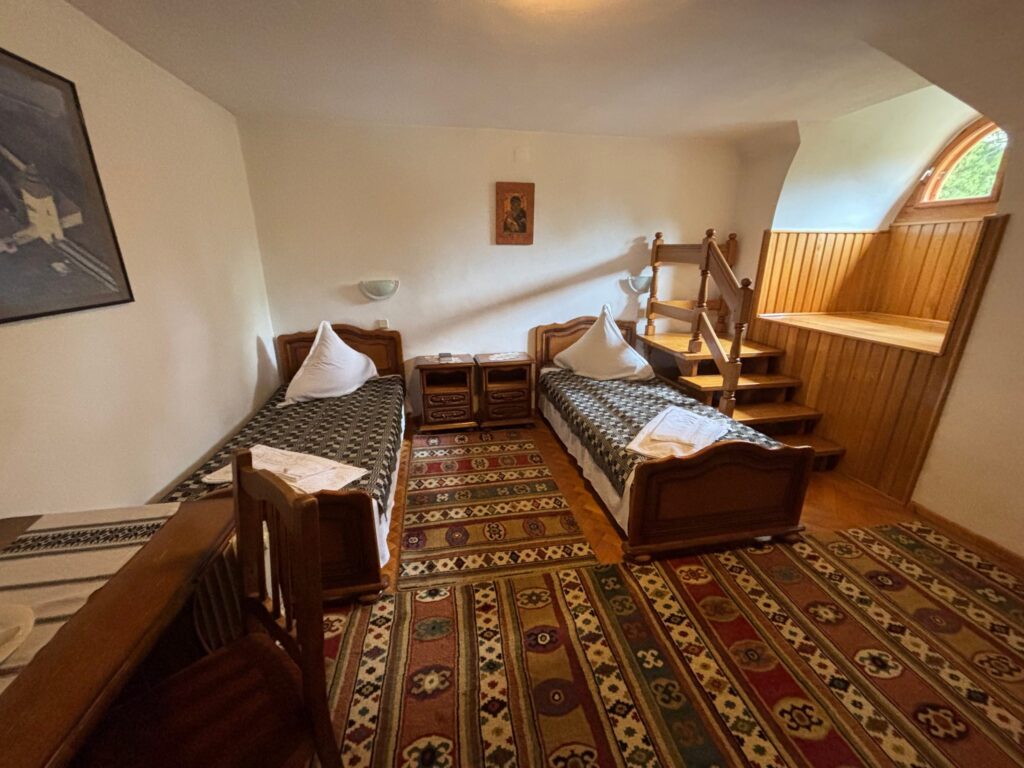
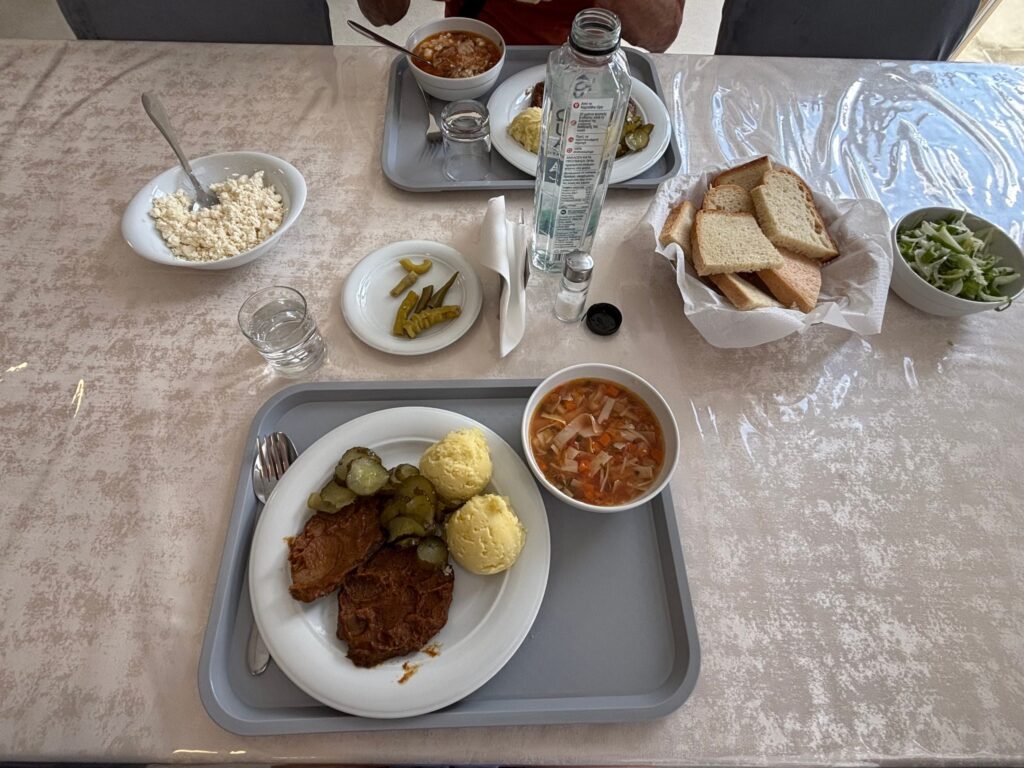
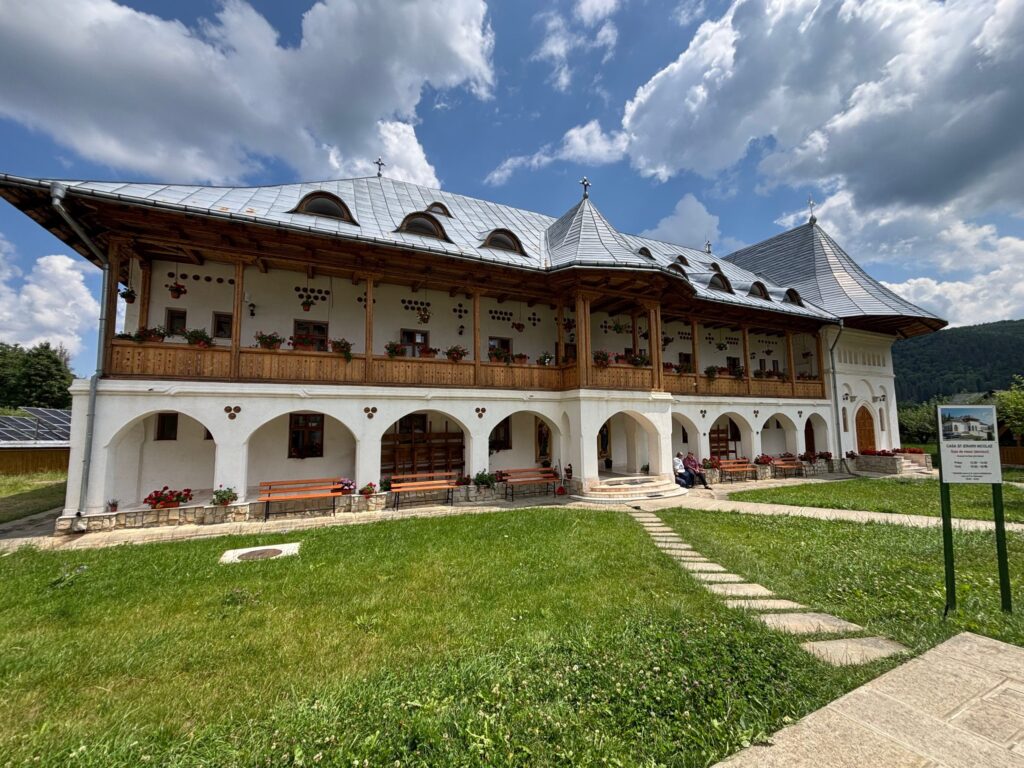
The monastic life in Putna. The rooms and food are standard monastery fare. Basic, simple, but clean and tasty. Just what you need and not more.
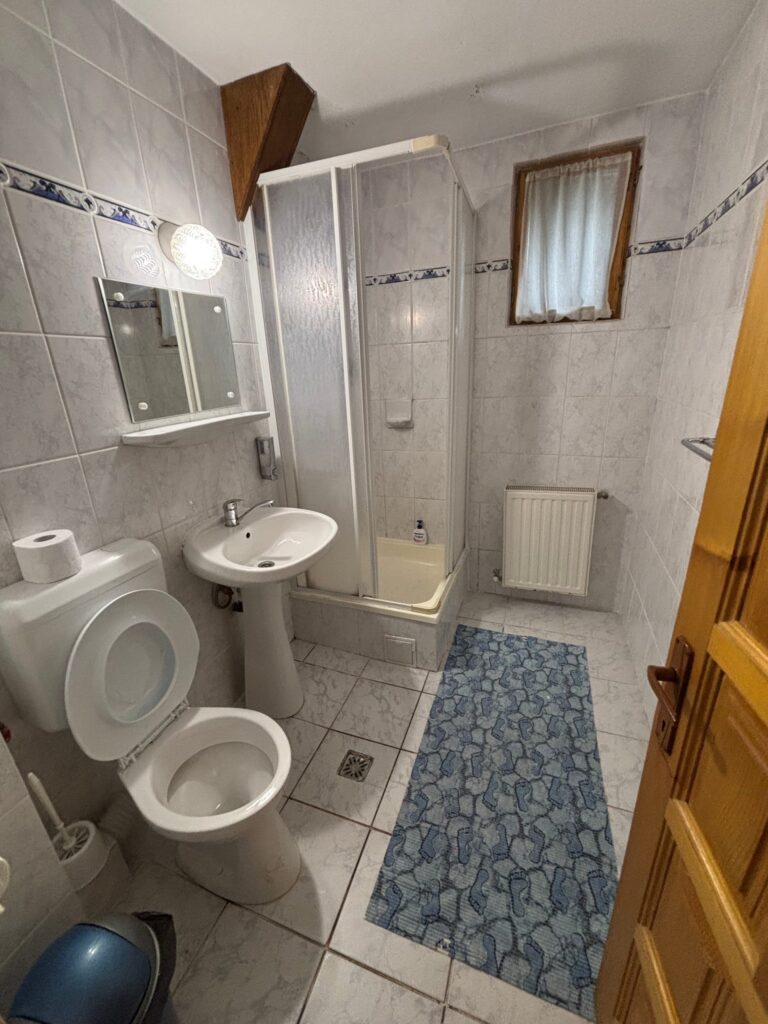
Fast facts about Romania 🇷🇴 from the Internet:
-
Romania is about the size of Oregon and is home to approximately 19 million people.
-
It sits at the crossroads of Central, Eastern, and Southeastern Europe, making it a fascinating blend of cultures.
-
Romania joined the Schengen Area in 2025, making border crossings within much of Europe easier.
🏛 The Romans
-
Romania is one of the few Eastern European countries whose language is derived from Latin.
-
The name Romania literally means “Land of the Romans.”
-
Emperor Trajan conquered the ancient kingdom of Dacia in 106 AD, and Roman influence still shapes the country’s language and identity nearly 2,000 years later.
-
You’ll find Roman ruins throughout the country, including roads, forts, and ancient cities.
🐺 The Dacians
Before the Romans came, the land was inhabited by the Dacians, fierce warriors known for resisting the Roman Empire.
Many Romanians view themselves as descendants of both the Dacians and the Romans—a blend of resilience and civilization.
🧛 Dracula vs. Vlad the Impaler
-
Dracula is based loosely on the real 15th-century ruler Vlad III, also known as Vlad the Impaler.
-
His nickname “Dracula” came from his father, who belonged to the Order of the Dragon.
-
Vlad became infamous for impaling enemies on wooden stakes to deter invaders.
-
Bram Stoker borrowed his name for the fictional vampire, but Vlad himself had nothing to do with vampires.
-
Ironically, Bran Castle, marketed as “Dracula’s Castle,” has little historical connection to Vlad.
🏰 Castles Everywhere
Romania has hundreds of castles, fortresses, and fortified churches, ranging from medieval strongholds to fairy-tale palaces.
The country’s Saxon villages contain some of Europe’s best-preserved fortified churches.
🌲 Nature
Romania is one of Europe’s wildest countries.
-
I’ve already told you about the BEARS!
-
Wolves, lynx, bison, and countless bird species still roam freely.
-
The Carpathian Mountains form the country’s backbone.
-
The Danube Delta is Europe’s second-largest river delta and one of the continent’s richest ecosystems.
🗣 Language
Romanian surprises many travelers.
Although surrounded by Slavic-speaking countries, Romanian is a Romance language, closely related to Italian, French, Spanish, and Portuguese.
Common words:
-
Bună = Hello
-
Mulțumesc = Thank you
-
Da = Yes
-
Nu = No
Many younger Romanians also speak excellent English.
⛪ Religion
Around 80% of Romanians belong to the Romanian Orthodox Church.
Religion remains an important part of everyday life, especially in rural communities where churches and monasteries are often the heart of the village.
🤝 Hospitality
Romanians have a reputation for being reserved at first but incredibly warm once you get to know them.
It’s common for strangers in villages to offer hikers:
-
fruit from their gardens
-
homemade food
-
coffee
-
plum brandy (țuică)
-
directions—even if no common language is shared.
Hospitality is deeply rooted in Romanian culture.
🍽 Food
Romanian cuisine reflects influences from Ottoman, Hungarian, German, Balkan, and Slavic traditions.
Must-try dishes include:
-
Sarmale (stuffed cabbage rolls)
-
Mămăligă (polenta)
-
Ciorbă (sour soup)
-
Mici (grilled sausages)
-
Papanasi (fried doughnuts with sour cream and jam)
🏛 Politics
Romania is a parliamentary republic with a democratically elected government.
The country emerged from decades of communist rule after the 1989 Revolution, when dictator Nicolae Ceaușescu was overthrown.
Today, Romania continues modernizing while balancing rapid economic growth with challenges such as infrastructure, emigration, and political reform.
🌍 Diversity
Romania is far more culturally diverse than many visitors expect.
Its regions each have distinct identities influenced by:
-
Romanians
-
Hungarians
-
Germans (Transylvanian Saxons)
-
Roma communities
-
Ukrainians
-
Serbians
-
Turks
-
Lipovan Russians
Each region has its own architecture, traditions, dialects, and cuisine.
Much love & gratitude. Namaste 🙏
Don’t forget to like and share this post, please. Thank you.
To see more photos and videos from my adventures, follow me on social media. Facebook, Instagram, YouTube, TikTok, BlueSky, and Threads or connect with me on LinkedIn.
The official app
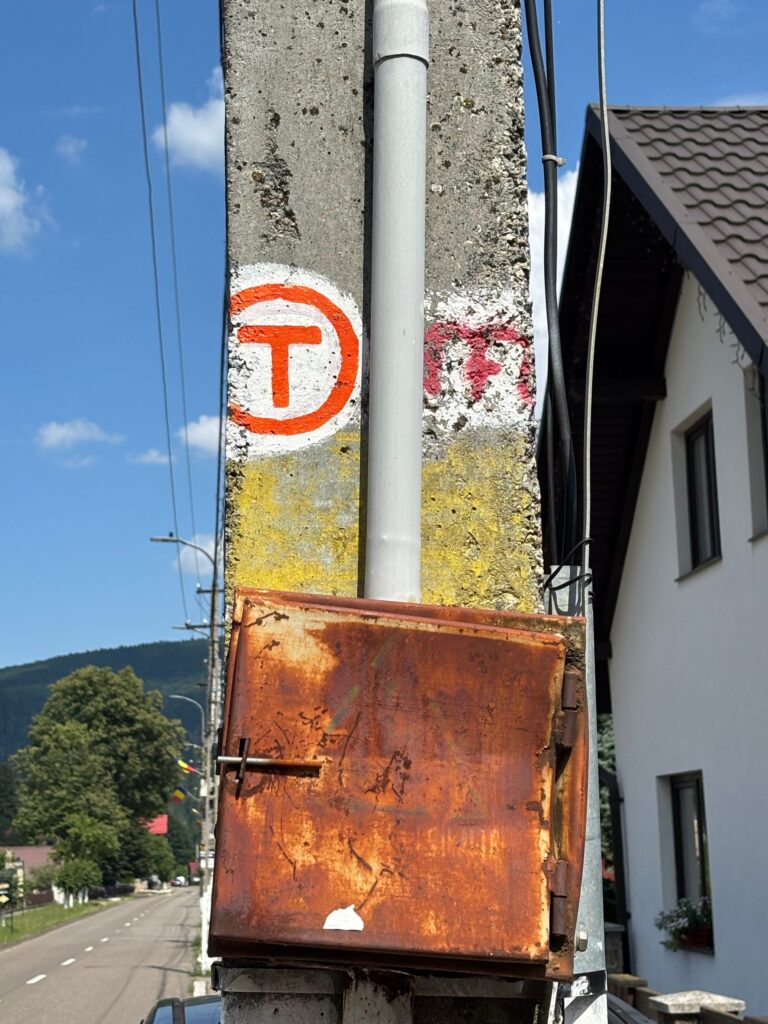
VT signage markers 🧡
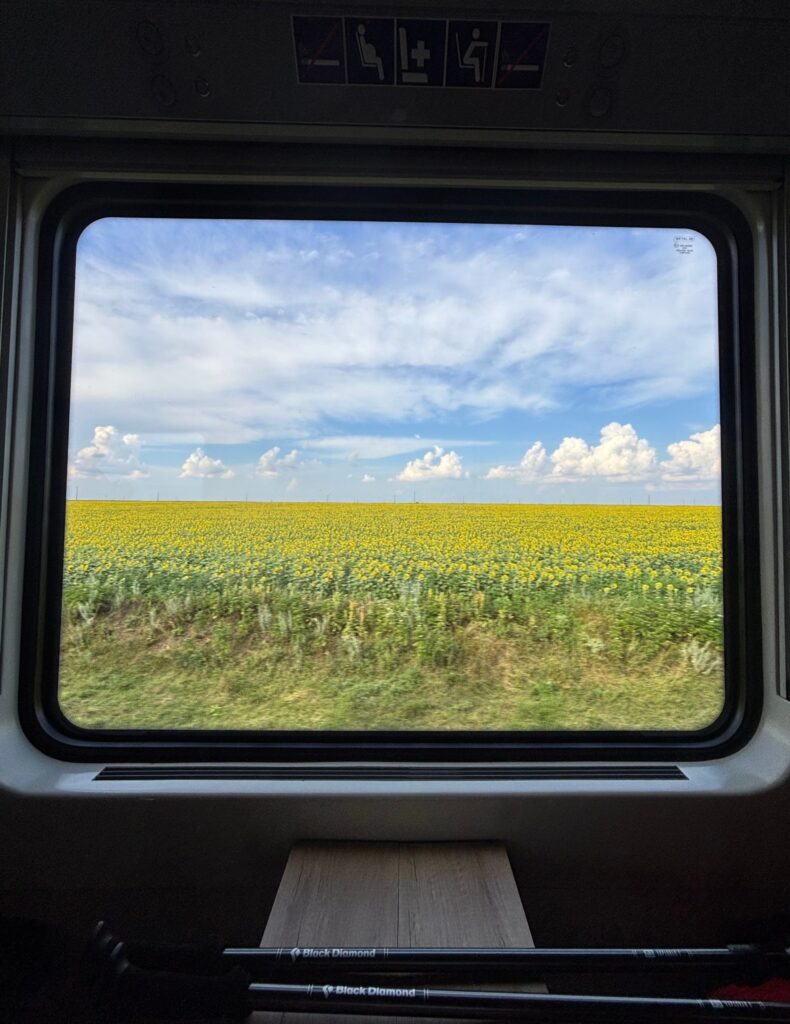
There are endless fields of sunflowers. It reminds me of Kansas. 🌻
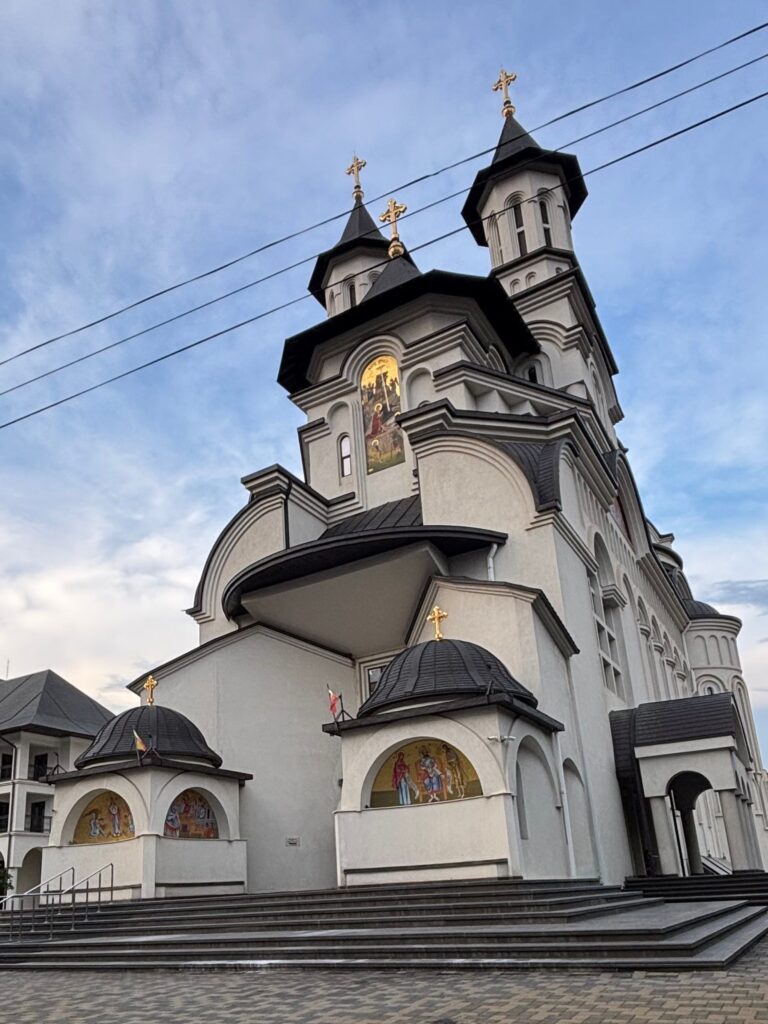
A church in Suceava.
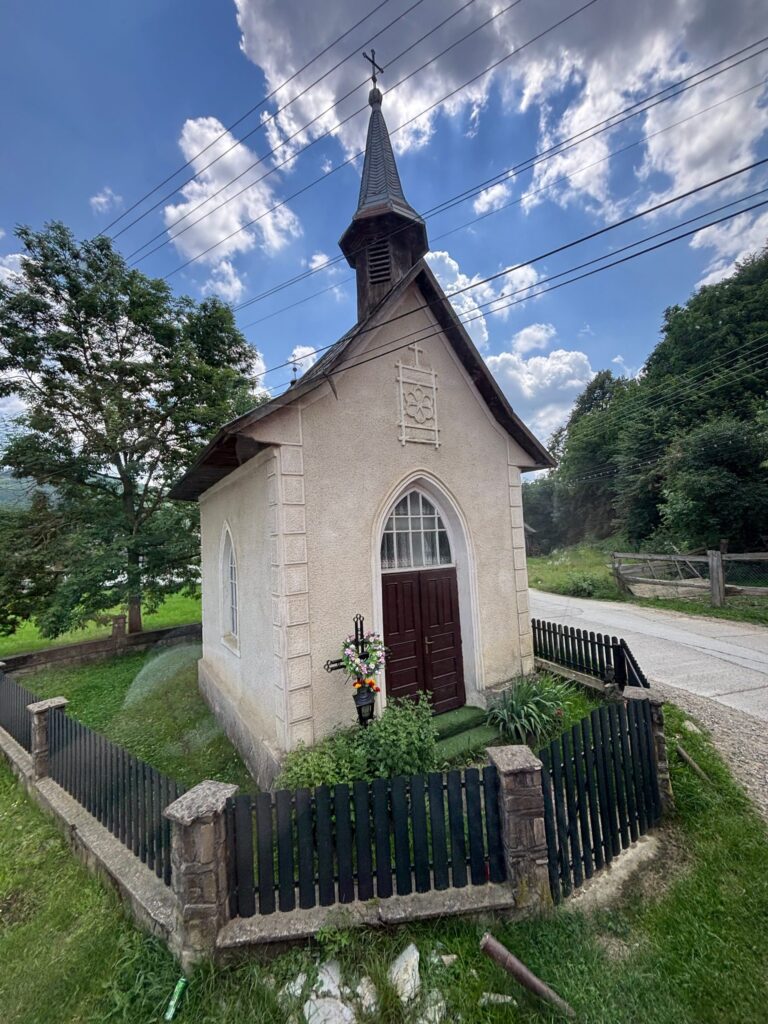
A tiny church on the way to Putna.
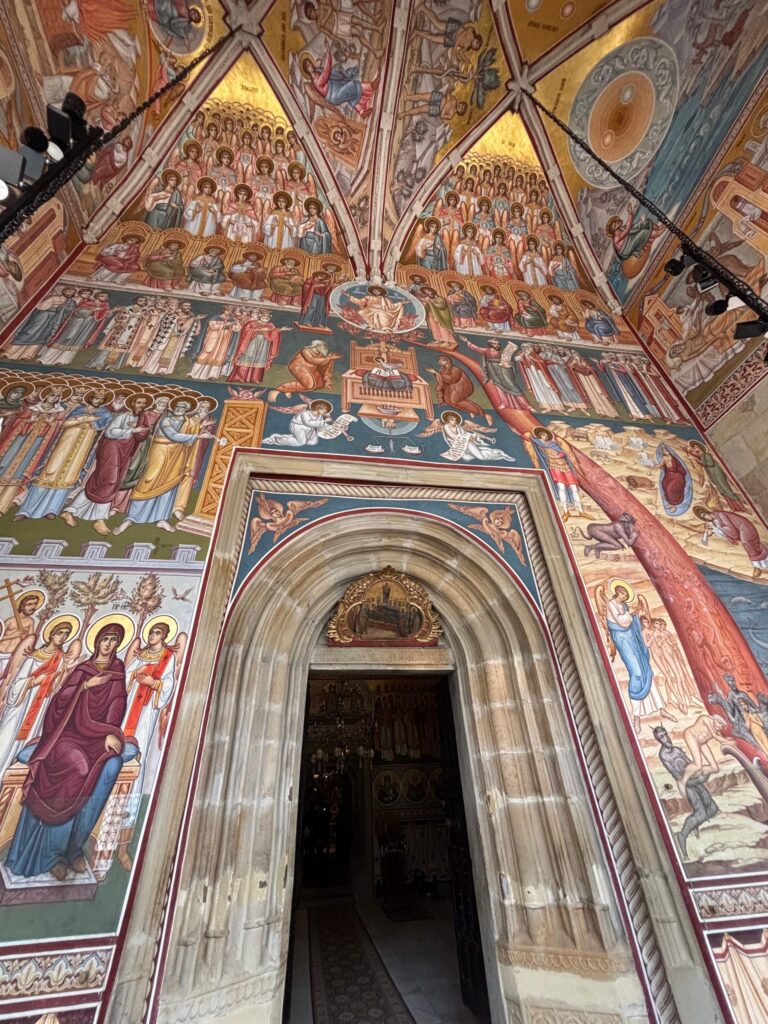
Inside the church at the Putna Monastery.
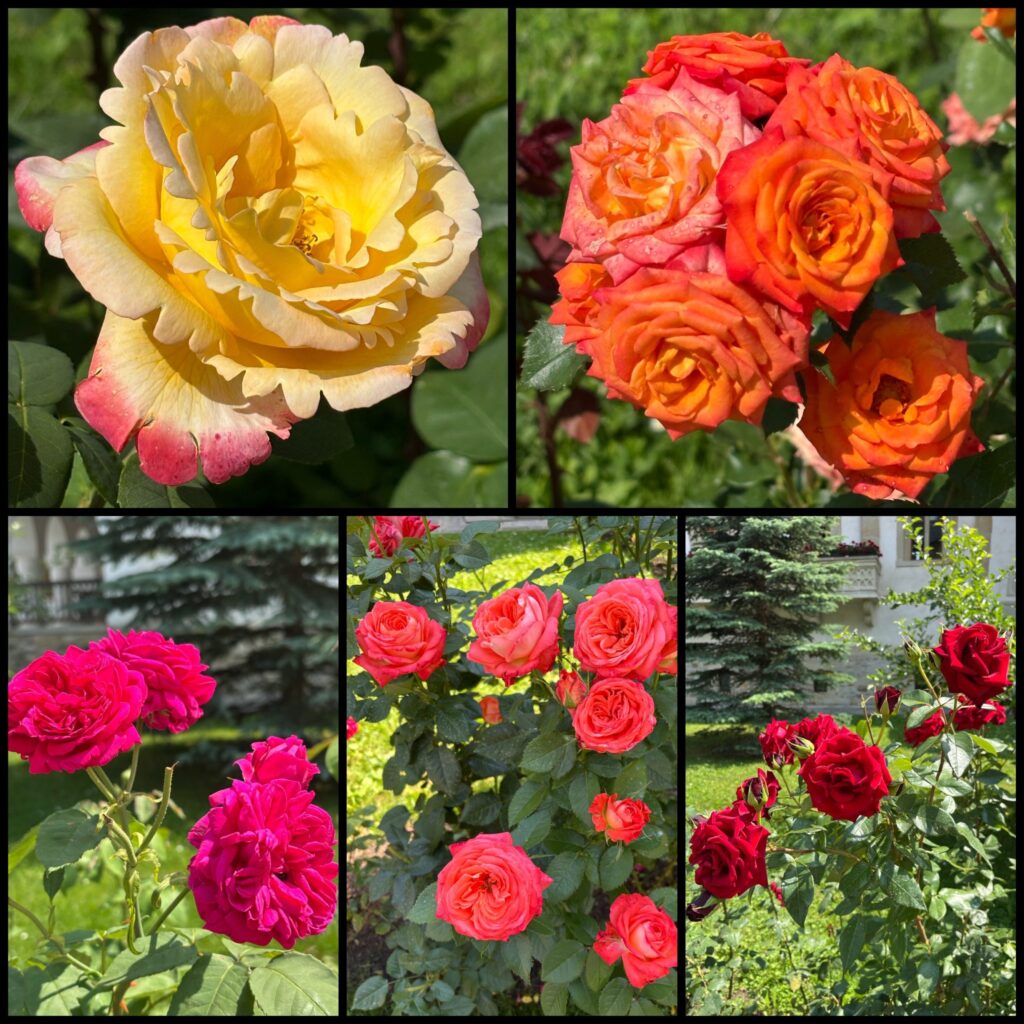
There are flowers everywhere, and the roses in particular smell amazing. Nature’s perfume.